I'm working as a freelance copywriter in Tokyo. Tokyo is a very exciting city and always inspires me a lot. Here, I'd like to write down what I think is interesting or just what I like because it would tell exactly who I am.
2020年5月27日水曜日
2016年5月29日日曜日
Ukiuyo-e Is a Media that Shows Us the lives of Edo People.
I went to an
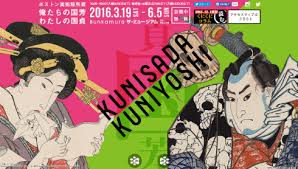
exhibition of Ukiyo-e or Japanese wood block printings entitled “Kuniyoshi
Kunisada,” which was held at the Bunkamura Museum in Shibuya.
Ukiyo in
Ukiyo-e originally means sorrow and short-lived(憂き), but the meaning changed to buoyant(浮き浮き)as the society became stable and people
started enjoying their lives in Edo, the largest city in Japan.
The unique
point of the exhibition is that the curator emphasizes the similarity of people
in Edo and the people of today.
Utagawa
Kuniyoshi and Utagawa Kunisada, who were the top two the most popular ukiyo-e
artists in Edo, vividly depicted the lives of Edo people. Through their works, we can see Edo
people are the same or more when it comes to appreciating the joy of
everyday.
The style of the two artists is quite
different. Kuniyoshi took the men
by storm with his dynamic images of warriors and his bold compositions, while
Kunisada intrigued women with his beautiful portraits of women.
I feel that their ukiyo-e
are like fashion magazines. In Kuniyoshi’s magazines(Ukiyo-e), there comes a young man wearing
a skull pattern kimono. He looks
like a punkish guy of the era. In
Kunisada’s fashion magazines, dazzling kabuki actors must have captured women fans.
↓Thank you very much for your click.
にほんブログ村
2016年3月24日木曜日
Takashi Murakami’s Superflat Collection
I went to the Yokohama Museum to
see “Takashi Murakami’s Superflat Collection.” You might think it’s the art work of Takashi Murakami, one
of the most successful artists in contemporary art, but it’s the display of
Murakami’s private collection as an energetic art collector. It was mind-boggling and incredibly
overwhelming.
The collection is assembled based
on the artist’s unique eye and aesthetic.
From contemporary art to antiques, from Japan and other countries, it
includes more than 5,000 items. I
think it’s more than a private collection in scale. It seems to be collected just by his instinct and I felt as
if I saw inside of his head.
Murakami is one of my favorite
artists. Especially, I like what
he is thinking and saying rather than what he is drawing. He is a great concept maker and an eloquent
speaker as well. I remember his
“declaration” for the exhibition “Super Flat Declaration” that he curated in
2001. It starts with this
phrase, “Japan might be the future of the world. And the Japan of today is SUPER FLAT.” So cool, isn’t it?
The declaration continues,
“…everything from society and public morals to art and culture is super two
dimensional.” He says “Super Flat”
is a new concept to understand Japanese original culture. Now, Japanese students learn
perspective and Western art at school.
The two dimensional structure has been disregarded since Japan
modernized in the Meiji era. However,
Murakami indicated that sense of two dimensional structure have been handed
down through games, manga, and animation culture.
In this exhibition, Murakami
expanded the definition of the concept “Superflat.” Everything in here seems to be equal in value. There is no historical period, no genre,
no hierarchies, and no logic in his collection. It’s the chaotic world, which is a mixture of good and bad,
valuable and invaluable.
As I expected, what he is
thinking is still super interesting!
Thank you very much for your click!
にほんブログ村
2016年2月10日水曜日
Yoko Ono: from My Window
![]() |
| photo: Museum of Contemporary Art,Tokyo |
I went to see an exhibition entitled
“Yoko Ono: from My Window” held at the Museum of Contemporary Art, Tokyo in
Kiyosumi-shirakawa. Yoko Ono is most
of thought of in her relationship with John Lennon, but she has been a great
artist in contemporary art long before she met him.
She is one of the pioneers of
conceptual art and I have been a big fan of her works. The exhibition emphasizes her very
beginning works in the 1960s’ including some events she held in Tokyo. Looking at the photos and videos at the
show, I was taken aback by how avant-garde they are. They are still interesting and inspiring to this day.
Why do I like her works? I took a moment to stop and think about
it. One reason is that her works
have the power to stir my imagination. For example, the “instructions for paintings” series. They are just displaying instructional
words on pieces of white paper like this:
Painting for the Wind
Cut a hole in a bag filled with
seeds of any kind and place the
bag where there is wind.
With this instruction, you can
imagine any process of changes after the seeds start spreading into the
air. Flying in the air, touching
down on the ground, germinating and covering the ground with green leaves. You can transfer the instructions to
your own vision. I think that the idea
Yoko Ono came up with is a beautiful invention. We can draw invisible pictures in our head and maybe, it’s
more creative than real pictures.
The second reason I like her
works is that her art works are always positive. There is nothing that scares me or depresses me in her works,
even if their themes were anti-war. I
can always feel happy with them.
After going through the
exhibition, I was fully charged with the energy.
↓Thank you very much for your click.
にほんブログ村
2015年12月23日水曜日
Mitate and Hiroshi Sugimoto
I went to the Chiba City Museum
of Art to see Hiroshi Sugimoto’s two part exhibition entitled “Past and Present
in Three parts” and “Art and Leisure.”
It was a compact but extraordinarily gorgeous exhibition, which takes in
his works including his three great photographic masterpieces and the “toko-no-shiturae,”
or artistic settings for a tea ceremony room alcove.
As a photographer, Sugimoto’s
works are very conceptual.
Generally speaking, photos reflect a moment, but he endeavors to show history
or the flow of time. One of his
masterpieces “seascape,” consisting of simply sea and sky, was created based on
his idea, “Is it possible for us to see the same scenery that ancient people
saw?”
His “theatre series,” consisting
of the white screen and the inside of a movie theater shows the passage of time
using time-lapse exposure. The
white screens in his photos seem to show nothing but they are the accumulation of
the light of 2-hour-movies. In a
sense, we can see a 2-hour-movie in a moment. For Sugimoto, taking photos doesn’t mean just reflecting the
real world. He shows us the time
we’ve never seen before.
Before he started his career as a
photographer, he was an antique art dealer in NYC. Still now, he is an art collector and with his expert eyes
on Japanese art he carefully chose the combinations of hanging scrolls and
artistic objects for a tea ceremony room alcove. The 27 combinations displayed in the “Art and Leisure”
section are innovative because he matched, for example, an old Japanese hanging
scroll and a portrait bust statue of Christ harmoniously.
Whenever I see his masterpieces,
they remind me of the word “mitate.”
It’s difficult to find an exact word in English, but it might be similar
to “metaphor” or “replacing something in a different image.” Mitate is a very basic way of thinking
in traditional Japanese arts, such as landscape design, noh play and pottery. Sugimoto’s mitate is always beyond my
imagination and that’s why I’m strongly fascinated with his works.
photos: Chiba City Museum of Art
↓ Thank you very much for your click.
にほんブログ村
2015年12月2日水曜日
My first Choju-Giga, scrolls of frolicking animals and humans.
One year has passed since I
started leaning Japanese style painting.
During the first nine months, I was not allowed to even grip a brush to
draw. Instead, I was told to
practice drawing lines, glasses, boxes and sketching flowers to acquire the
very basic skills, which is useful for both Japanese and Western painting.
At last, the time has come! After going through the long boring
period of training, I reached the starting point to begin Japanese style
painting. My first lesson was
replicating some of the scenes from Choju-Giga, or scrolls of frolicking animals
and humans. OMG! It’s one of my favorite art
pieces. It was too good to be
true.
Choju-giga were drawn in the
Heian period by Toba Sojo and other painters. It depicts the life of wild animals such as frogs, rabbits
and monkeys as if they were human beings.
A frog and a rabbit are playing sumo wrestling. Some rabbits are playing archery. The livery description of animals
evokes some feelings like how wonderful our lives are.
Choju-Giga is considered to be an
origin of Japanese manga, or comics.
Although they don't have any speech balloons on the screen, I can
imagine the sounds of laughing, singing and shouting coming out of the
picture.
Replicating pictures is a good
way to come very close to the painters.
When I trace the lines, I feel the breath of the artist. “Maybe, he must have stopped his brush
here” or “he might have been confident with this strong stroke.” As I copied his lines, I could
understand more about this picture than when I was just looking at them.
↓Thank you very much for your click
にほんブログ村
2015年11月18日水曜日
Raf Simons's days in Christian Dior.
I was very surprised to know that Raf Simons, the artistic
director of Christian Dior, left the most prestigious fashion house after his
three and a half years contribution.
“Dior and I,” is a
fashion documentary film that depicts Raf’s eight weeks, from day one when he
started working for Dior till his debut haute couture collection of fall-winter
2012. Initially, I thought it’s
just a behind the scene fashion movie, but it was much more than I
expected. On the contrary, it
became one of my favorite movies of the year 2015.
Raf had been a director of Jil Snder, a Milan fashion brand, which
is characterized as sharp with modern line and form. As for Dior, it’s the most elegant and feminine brand. People were very curious how Raf, a
minimalist, would meet the high demands and create his own Dior style when he
took the position as a director of Dior.
A haute couture collection usually takes six to eight months to prepare,
but Raf was given only eight weeks.
What is worse, he had never designed haute couture before. The movie reveals all the process of
making the collection including some conflict with staff members and Raf’s
nervousness as well.
What impressed me most is Raf’s attitude. He is calm, shy and restricted rather
than arrogant and self-indulgent, which people in the fashion industry are
likely to be. He is intensely
focused and never loses control until the end. He knows exactly what is required, that is, a mixture of
Raf’s modern minimalism and Dior’s legacy. It’s easy to say, but when I saw his final output, I knew he
did it in a perfect way.
Nowadays, almost everything seems to be determined by
marketing. People are likely to
rely on the analyzed data and figures because they don’t want take any risks. As for Christian Dior, Raf’s
inspiration and creativity itself was the marketing that showed the big brand
the way to go.
Under the incredible pressure of high expectations, he must have
carried a heavy load on his shoulder.
Raf explained the reason why he left Dior as “personal” only. Anyway, I’m looking forward to seeing
his next challenge after leaving Dior.
The trailer of "Dior and I"
You can see the details of Raf Simons's first show
that was introduced in the "Dior and I."
Christian Dior Paris Fashion Week Haute Couture
2012/13 AW held on July 2nd 25 min
Raf Simons’s last collection for Jil Sander 2012/13 AW.
It was held just before he moved to Christian Dior.
It’s mesmerizing.
↓Thank you very much for your click.
にほんブログ村
2015年11月4日水曜日
Taken on a visionary trip. Yubiwa Hotel’s performance at Echigo-Tsumari Art Triennale.
![]() |
| photo: Tsunan Shinbun |
This autumn, I went to Niigata to
see a Yubiwa Hotel’s performance, titled “But I was so in love ---Tsunan-machi
Okura snow shed version,” or あんなに愛しあったのに〜津南町大倉雪覆工篇, held at the Echigo-Tsumari Art Triennale. Yubiwa Hotel is one of my favorite
performance units and I had longed to see this performance since I saw it last timeat Ichihara Art×Mix in 2014.
Shirotama Hitsujiya, the director of Yubiwa Hotel has a
unique way of making dramas. She trys
to find “treasures” of the local area by doing ethnological research and creating
stories based on them. This time, the drama is set in Tsunam-machi, a remote
area in Niigata pref., which has heavy snow in winter.
We got to the Tsunan-machi Okura snow shed, which
Hitsujiya selected as the stage for this performance. The Okura snow shed, located just along the Shinano River,
used to be a snow shelter to protect the local road and people from heavy
snow. We, the audiences were asked
to walk back and forth through the snow shed with the actors as the story went
on. Basically, the shed became the
tunnel that connects the real world with fantasy.
Having heavy snow, sometimes over 4 meters a day in
winter, and a decreasing population, Tsunan-machi has a lot of
difficulties. The drama starts
when the schoolgirls who belong to “social study club” introduce the history and
some legends of the region. The
play seems to raise several important matters; how can we cope with this
situation and how can we figure out any solutions. However, it’s not a social scientific drama, on the
contrary, soon before we know it, we are drawn into a beautiful fantasy.
One schoolgirl says;
“Teacher, can we also become snow? If so, we would be able to come back
here again.”
I think these words are a great invention of this drama
because it is a fantastic solution to the problem that this remote area
has.
And then, winter comes and snow starts falling on the
ground of Tsunan-machi with a snow fairy, or yukimushi. The aerial dance that expresses the
snow fairy was breathtaking and we saw the image of people coming back to their
hometown by transforming themselves into flakes of snow.
Although there aren’t so many words in this drama or possibly
because there aren’t so many words, the performance appeals to our senses and
we feel at one with the fantasy that Hitsujiya created.
↓Thank you very much for your click.
にほんブログ村
2015年3月24日火曜日
Taking a stroll around “Kachikura,” a hot creative place.
Have
you ever heard ‘kachikura’? It’s
the name of a district located eastern part of Tokyo, from Okachimachi to
Kuramae in Taito ward.
(Asakusa is also in Taito ward
and adjacent to this area)
The
area used to be a town, where handicraft artisans who succeeded to the traditional
craftsmanship gathered. There are
still many wholesalers and shops specializing in fashion items, such as hats,
wallets, bags, jewelry and accessories and we feel remains of center of manufacturing
here, although it has lost a bit of its past glory.
Recently,
this area has been spotlighted again as a new manufacturing place and has
attracted young creators. The
history of the craftsmanship might have inspired young talented people and encouraged
them to invent something new. They
started their own brands, shops, cafes and galleries and it seems to boost the
manufacturing movement here in Kachikura more.
The
other day, I went for a stroll about the town. Hanging out the area, I found many shops and nice fashion
items that are based on the traditional craftsmanship.
The vicinity of Kuramae station, I
visited Koncent (variety store), Maito (dyeing and weaving), Camera
(leather goods and café) and Kakimori (stationary). Please take a look at my new notebook with flower print. It’s quite nice and lovely, isn’t
it? I made it at Kakimori that specializes
in original notebooks and ink. They
have a variety of sheets of paper and parts of notebook and all you have to do
is just choose your favorite materials.
For a lover of paper like me, Kakimori is a must.
When you head for Okachimachi from
Kuramae, you’ll find an old building in the back street. It’s Taito Designers Village. The building once housed an elementary
school has now become incubator offices for young entrepreneurs. Taito local government started this
project in 2004 to assist young designers in launching their businesses.
![]() |
|
Taito Designers Village
|
![]() |
|
On the face of it, the area seems to be a business
district but, once you are bit away from the main street, you’ll find some old Japanese houses like this. |
When you get to Okachimachi station, you’ll come across a unique facility called 2k540. It utilizes beneath the elevated JR rail line and develops an artisan’s street. Combining studio and shop, it shows us not only products but also artisan’s craftsmanship.
![]() |
|
2k540
is located between Okachimachi and Akihabara
and its name means 2 km and 540m away from a starting point at Tokyo station. Oh,yes? |
I
joined a workshop for gold gilding and made post cards at Nihon
Department. The artist
(instructor) walked me through making cards and I made wonderful ones even if
it was my first experience. It was
really wonderful time for me.
![]() |
|
I made
these cards. I think I can’t use them because they are too beautiful.
Maybe, I will display them on the wall. |
Kachikura
is very fun to visit and it’s more than I expected.
↓Thank you for your click
にほんブログ村
登録:
投稿 (Atom)